
From Tapping on Pipes to AI: The Evolution of Communication at Hogan

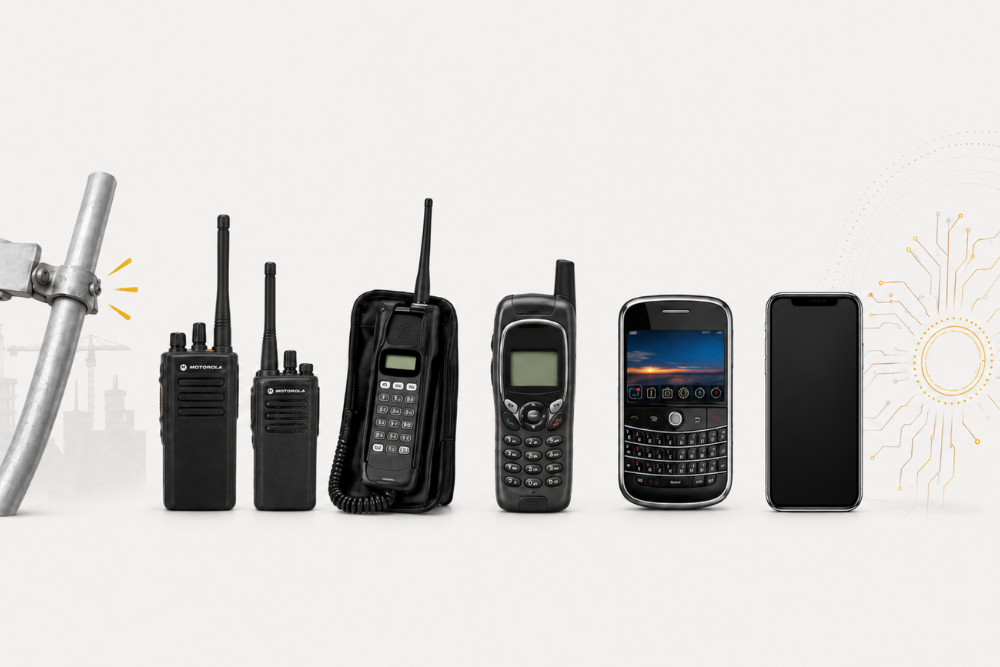
When we started Hogan in 1986, our communications system was about as simple as it gets. We had one business landline, one van and a lot of face-to-face conversations.
The van was a sweet 1978 Chevy with whitewall tires, no power steering and no air conditioning. She was a honey. We would meet in the morning, organize our prints, load the van and cruise out to the jobsite.
We were strictly a structured cabling company then, and trust me, the business phone was not exactly ringing off the hook.
Once we arrived at a jobsite, communication became even more basic. We worked in teams and developed a rough version of Morse code for pulling cable through conduit. One pattern of taps meant feed the cable. Another meant stop. There may have been one or two other messages, but that was about the extent of our vocabulary.
It sounds primitive now, but this was before affordable two-way radios and before cell phones were a practical option. We used the tools available to us, and sometimes the best communications technology on the job was simply a length of pipe and someone paying attention at the other end.
Enter the Two-Way Radio
As the business grew, so did our communications budget.
Our first major upgrade was a set of Motorola two-way radios that could access a repeater. These were professional devices, not the inexpensive walkie-talkies available today. Depending on the model and features, each radio could cost approximately $600 to $1,200.
They made communication between crews much easier, but we were not always gentle with them.
A construction site can be a punishing environment for electronics. The radios were dropped, knocked around and exposed to dust and weather. They routinely broke down, and repairing or replacing them was expensive.
Even so, they were a major improvement over tapping on conduit.
The Cellular Bag Phone Arrives
We embraced cellular technology early.
I owned one of the classic cellular bag phones, a behemoth with a short, stiff cord connecting the handset to the main unit. I placed it on the center console and plugged it into the cigarette lighter for power. The vehicle also needed an external antenna installed and wired specifically for the phone.
The whole setup was expensive and clumsy.
I remember answering calls while driving and having the cord wrap around the steering wheel as I turned. It was not exactly the safest arrangement.
Those bag phones transmitted at up to three watts. A typical modern smartphone transmits at a maximum of around 0.2 watt, meaning the old phone had approximately 15 times the transmitter power.
Whether that was a good thing to have sitting beside me for hours is a question I probably should have asked at the time.
Nextel Changes the Jobsite
Our next major leap came when we moved to the Nextel cellular network.
Nextel phones combined regular cellular service with Direct Connect, a push-to-talk feature that worked like a two-way radio through the cellular network.
These phones were a game changer.
We could communicate with crews at the jobsite, reach someone individually or talk to an entire group. At the office, we installed a base station with a desktop microphone that looked and felt much like a CB radio microphone. Press the button, hear the familiar chirp and talk to the team.
Unlike traditional radios, Nextel communications could travel across cities or states as long as everyone had network coverage.
That improved coordination, reduced delays and made our cabling crews significantly more efficient.
From BlackBerry to iPhone
Then corporate America began moving toward smartphones, especially BlackBerry devices.
Suddenly, a phone could send and receive email and text messages. BlackBerry became so addictive that people nicknamed it the CrackBerry because users could not stop checking their messages.
I tried one, but I was not its biggest fan. Within a few months, I moved to a Nokia. From there, we used a variety of smartphones before I was finally convinced to switch to an iPhone.
If I remember correctly, my first was the iPhone 4. Released in 2010, it had the first Retina display on an iPhone, 16 GB or 32 GB of storage and a glass front and back. The design was beautiful, although the glass construction could also be described as, “I will shatter if you drop me anywhere.”
Its five-megapixel rear camera and 720p video recording were advanced for the time.
I still use an iPhone today. Most of the team has moved to Android phones, but I am a creature of habit. I never imagined carrying an advanced computer with multiple cameras, artificial intelligence, wireless charging, satellite communications and access to nearly every piece of information I need.
The Office Evolved Too
The evolution was not limited to mobile devices.
Our office communications progressed from a single landline to a hardwired key system with multiple lines. We then adopted SIP service with an on-premises VoIP phone system, followed by cloud VoIP. Today, we use unified communications as a service, complete with SMS capabilities and CRM integration.
Each step changed more than the equipment. It changed how quickly we could respond, how effectively we could coordinate and how well we could serve our clients.
Looking back, communications at Hogan have run the full gamut: landlines, tapping on pipes, Motorola radios, cellular bag phones, Nextel push-to-talk, BlackBerry, Nokia, iPhone, cloud calling and fully integrated communications platforms.
What an amazing trip it has been.
We have watched several new industries come to life, mature and sometimes disappear. Now we are heading rapidly into the age of artificial intelligence.
Buckle up. If the journey from tapping on pipes to carrying AI in our pockets has taught us anything, it is that the next chapter will arrive faster than we expect, and it will be fascinating.